
How to Write an AI-Use Declaration for a Chinese Thesis or Dissertation (with Template)
Learn how to write an AI-use declaration for a Chinese university thesis, with May 2026 guideline rules, university comparisons, and bilingual templates.
Short answer: core arguments, research design, and innovative contributions in a Chinese university thesis or dissertation must be completed independently by the degree candidate; whenever generative AI tools are used in auxiliary steps permitted by your university, you should proactively include a truthful AI-use declaration (人工智能使用声明) stating the tool name and version, purpose, exact chapters or sections affected, dates of use, human verification steps, and an explicit statement of full author responsibility. Always check your own university's and supervisor's rules before starting—some faculties explicitly prohibit using AI even for language polishing or translation.
Why Chinese theses now require an AI-use declaration
For international degree candidates, English-taught graduate cohorts, and bilingual students completing a thesis or dissertation in China, generative AI compliance is governed by both national guidance and institution-specific regulations. According to ScienceNet.cn's report on the Guidelines on Regulating the Use of Artificial Intelligence Tools in Graduate Theses, Dissertations, and Practical Achievements (《规范研究生学位论文与实践成果中人工智能工具使用指南》)—developed by the Chinese Society of Academic Degrees and Graduate Education (中国学位与研究生教育学会) under commission from the Ministry of Education's Department of Degree Management and Postgraduate Education (教育部研究生教育司) and released on May 14, 2026 (note: the four points below are summarized from authoritative media reporting; always refer to the official text and your degree-granting institution's regulations)—graduate degree work involving AI tools rests on four principles:
- Core originality baseline: Core arguments and innovative contributions must be proposed and completed independently by the degree candidate.
- Reasonable auxiliary use and strict verification: AI tools may be used reasonably across topic exploration and study design, literature review or background synthesis, thesis or report drafting, artifact creation, and defense presentation, provided all outputs undergo strict critical review and verification by the candidate.
- Proactive AI-use declaration: Theses, dissertations, and practical achievement reports should proactively include an "AI Use Statement" (
人工智能使用声明) disclosing the tool name, version number, official website URL, intended purpose, specific stages or sections, parameter settings, and human verification process. - Oral defense questioning procedure (
答辩质询程序): Oral defenses in principle incorporate questioning on AI tool usage to verify that the candidate genuinely commands the core reasoning, data, and assisted steps.
An AI-use declaration is therefore not a waiver permitting pasted AI prose; it is an academic integrity record documenting auxiliary boundaries, verification steps, and authorship accountability for your supervisor, external reviewers, and defense committee.
How Chinese university rules differ: published institutional examples
While the May 2026 national guideline sets the overarching framework, individual Chinese universities differ sharply on permitted tasks, AIGC detection thresholds, and where the declaration is bound. The table below summarizes published rules from selected Chinese institutions; candidates at other universities must follow the current notice issued by their own graduate school or academic affairs office:
| University (Degree Level) | Official Policy Document | Explicitly Prohibited or Restricted Uses | Declaration Title, Placement & Detection Rule |
|---|---|---|---|
Beijing Institute of Technology (北京理工大学, Master's / Doctoral) | Graduate School Notice 研函〔2026〕024号 | Hand-signed originality statement; prohibits plagiarism, fabrication, falsification, and ghostwriting or paper purchasing | Adopts the five-part structure of GB/T 7713.1—2025 (see standard record page); no standalone AI clause in this formatting document—follow university and supervisor rules |
Xi'an Jiaotong University (西安交通大学, Graduate) | Graduate Guidance 西交研〔2025〕163号 | Forbidden for thesis structure, study design, or innovative method design; prohibits direct copying of AI text; classified/confidential theses strictly barred from AI use or upload; requires supervisor consent | Include 《AI 工具使用情况说明》 in the Appendix; retain key raw input materials and AI outputs for audit |
Jiangsu University School of Medicine (江苏大学医学院, Graduate) | March 2026 Notice | Prohibits generating core claims, methods, conclusions, body text, or acknowledgements; prohibits language polishing and translation; prohibits generating or altering raw data or key figures | AI feature value must not exceed 20% of full text; list AI tool details in References and submit a usage note to the supervisor |
Communication University of China (中国传媒大学, Graduate) | October 2025 Specification | Failure to disclose actual usage truthfully is treated as non-compliant use | Front-matter integrity statement (non-users must also sign a non-use declaration), on-page footnotes in the body, and 《关于人工智能使用的声明》 in the Appendix |
Nanjing University of Aeronautics and Astronautics (南京航空航天大学, Bachelor's) | March 2026 Revised Specification | Core content must be original; prohibits AI data falsification/fabrication or similarity-check evasion | Integrity pledge includes an AI clause, plus a standalone unpaginated front-matter form 《AI工具使用情况说明表》 |
Hunan University of Science and Technology (湖南科技大学, Bachelor's) | Undergraduate Notice 本科生院〔2026〕40号 | An "AI ghostwriting ratio" (AI代写比例) of 40% or above fails screening | "AI ghostwriting ratio" must be below 40% (alongside similarity-ratio limits) before entering the oral defense |
Beijing Normal University (北京师范大学, Bachelor's) | Academic Affairs Notice 师教培养〔2026〕11号 | Strictly prohibits ghostwriting, plagiarism, fabrication, and related misconduct | Requires clear, prominent labeling or declaration; notes explicitly that AIGC detection is probabilistic and serves as an auxiliary reference only, not as proof of originality |
Two practical contrasts stand out for students preparing a thesis in China. First, the same task can be permitted at one faculty and banned at another: for example, Jiangsu University School of Medicine explicitly prohibits AI language polishing and translation, whereas Communication University of China permits disclosing paragraph-level polishing alongside revision details. Second, AIGC detector scores are governed differently: some schools enforce numeric ceilings, while others such as Beijing Normal University treat detector outputs as advisory only—and universities uniformly treat "AIGC-reduction" paraphrasing tools aimed at evading review as misconduct.
Six essential elements of a thesis AI-use declaration
Whenever your university does not issue a fixed form and asks you to draft a written statement, cover six elements (adding the official URL and parameter/prompt summaries as well if your department adopts the full May 2026 national guideline checklist):
- Tool name and version: Specify the exact software or model name and version number (plus developer and official URL where required), rather than writing vague phrases like "a large language model."
- Specific purpose: Define the exact auxiliary scope—such as organizing literature search leads, structuring a rough outline from your own research notes, debugging statistical code syntax, or checking grammar in an English abstract (provided your institution permits that use).
- Affected chapters and sections: Cite exact chapters, section numbers, paragraphs, or analysis scripts rather than writing "selected chapters."
- Dates of use: State the year and month or exact date range matching your archived working notes.
- Human verification process: Explain how you audited and rewrote the material—for example, checking every cited article against primary Chinese and international journal databases, recomputing statistical fits in independent software, and rewriting paragraphs from your own lab records.
- Responsibility statement: Confirm that core arguments and innovative contributions were completed independently by you, that all assisted content was reviewed and revised by you, and that you take full responsibility for the entire thesis.
Copyable bilingual AI-use declaration templates (Chinese and English)
If your graduate school or department provides a mandatory form, fill out that official form directly. Otherwise, adapt the Chinese or English templates below according to the language of your thesis and your institution's filing rules.
1. Concise paragraph templates (aligned with SciVolume disclosure wording)
Graduate thesis or dissertation (Chinese & English):
人工智能使用声明:本论文撰写过程中使用了 [工具名称,可附官方网址](版本:[具体版本号]),用于[具体用途],涉及 [具体章、节名称及编号],使用时间 [年月或起止日期]。验证过程:[人工核对原始文献、实验数据及逐段改写的具体方式]。相关内容均经本人审查、修改,本人对论文全部内容负责。AI Use Statement: During the preparation of this thesis/dissertation, [Tool Name, with official URL if required] (version: [Version Number]) was used for [specific permitted purpose] in [exact chapter and section numbers] during [month/year or date range]. Verification: [how primary literature, experimental data, and rewritten passages were manually verified]. All such content was reviewed and revised by the author, who takes full responsibility for the thesis.Bachelor's thesis or graduation design (Chinese & English):
AI 工具使用情况说明:本毕业设计(论文)撰写过程中使用了 [工具名称](版本:[具体版本号]),用于[具体用途],涉及 [具体章节],使用时间 [日期]。相关内容均经本人核实、修改([核实方式说明])。AI Tool Usage Note: [Tool Name] (version: [Version Number]) was used in preparing this undergraduate thesis/design for [specific permitted purpose] in [exact chapters/sections] on [date or date range]. All such content was verified and revised by the author ([brief description of verification steps]).2. Itemized appendix declaration template (Chinese & English, for detailed audit and defense review)
# 人工智能使用声明

本人在指导教师知情同意下,在学位论文部分辅助环节规范使用了人工智能工具,现如实声明如下:

1. **原创确认:** 本论文核心论点、研究设计、原始实验与调查数据、分析结论及创新贡献均由本人独立完成,未用人工智能代写论证或虚构篡改数据图表。
2. **使用明细:**
   - **项目 1:** 工具 `[名称]`(版本:`[版本号]`,网址:`[官方网址]`);时间:`[起止年月]`;位置:`[第 X 章 X.Y 节]`;用途与参数说明:`[具体用途及参数/提示概述]`;核实过程:`[核对原文与逐段重写说明]`。
   - **项目 2:** 工具 `[名称]`(版本:`[版本号]`);时间:`[日期]`;位置:`[第 X 章脚本 / Abstract]`;用途与核实过程:`[代码复核或术语审定说明]`。
3. **责任承诺:** 重要原始输入材料与修改记录已留存备查。相关内容均经本人审查、修改,本人对论文全部内容负责。

学位申请人签名:__________    日期:____年__月__日
# Statement on the Use of Artificial Intelligence
With the knowledge and approval of my academic supervisor, I used artificial intelligence tools in permitted auxiliary stages of this thesis/dissertation and declare the details truthfully as follows:
1. **Originality Confirmation:** All core arguments, research designs, primary experimental or survey data, analytical conclusions, and innovative contributions in this thesis were completed independently by me. No AI tool was used to ghostwrite arguments or to fabricate or alter data or figures.
2. **Itemized Usage Log:**
- **Item 1:** Tool `[Name]` (version: `[Version]`, URL: `[Official URL]`); Period: `[Start–End Month/Year]`; Location: `[Chapter X, Section X.Y]`; Purpose & parameter summary: `[Permitted auxiliary task and prompt/parameter overview]`; Verification: `[Manual verification of primary sources and paragraph-by-paragraph rewriting]`.
- **Item 2:** Tool `[Name]` (version: `[Version]`); Date: `[Date]`; Location: `[Chapter X script / Abstract]`; Purpose & verification: `[Independent code verification or terminology review]`.
3. **Responsibility Undertaking:** Key raw input materials and revision records have been retained for inspection. All assisted content has been reviewed and revised by me, and I take full responsibility for the entire thesis.
Candidate's Signature: __________ Date: YYYY-MM-DD3. Fictional completed example (Chinese & English)
人工智能使用声明(虚构示例): 本论文撰写过程中使用了 SciVolume 写作工作台(版本:2026.11)及 Python 辅助排错工具,用于基于本人实验记录与已核验文献目录整理第 1 章绪论初稿结构、排查第 3 章动力学拟合脚本语法错误及英文摘要语法检查,涉及第 1 章 1.2 节、第 3 章 3.3 节脚本与 Abstract,使用时间 2026 年 9 月至 2026 年 11 月。验证过程:第 1 章引用的 42 篇文献均已核对期刊原文并由本人重写评述;第 3 章拟合结果已用 Origin 独立复算一致;英文摘要已对照中文摘要逐句审定术语。相关内容均经本人审查、修改,本人对论文全部内容负责。
AI Use Statement (fictional example): During the preparation of this thesis, the SciVolume writing workspace (version: 2026.11) and a Python syntax-debugging helper were used to organize the initial outline of Chapter 1 from my own laboratory notes and verified bibliography, debug syntax errors in the kinetic fitting script in Chapter 3, and check grammar in the English Abstract—affecting Chapter 1 Section 1.2, the Chapter 3 Section 3.3 script, and the Abstract between September 2026 and November 2026. Verification: all 42 references cited in Chapter 1 were checked against full-text journal articles and the commentary was rewritten by the author; Chapter 3 fitting outputs were independently recomputed and confirmed in Origin; and every sentence of the English Abstract was reviewed against the Chinese abstract for technical terminology. All such content was reviewed and revised by the author, who takes full responsibility for the thesis.
Where to place the declaration in a Chinese thesis
Bind the declaration wherever your university's official thesis template specifies; across Chinese institutions, four placements are standard:
- Standalone Appendix or back-matter section (most common): Under the five-part GB/T 7713.1—2025 thesis layout, placed in the Appendix area after References and before the list of publications achieved during the degree program (as required by Xi'an Jiaotong University and Communication University of China).
- Front-matter integrity statement or usage form: Bound immediately after the signed originality statement and before the Chinese abstract (such as Nanjing University of Aeronautics and Astronautics' front-matter
《AI工具使用情况说明表》). - On-page footnotes or supplementary reference entries: Added as page footnotes where assisted content appears (Communication University of China) or listed in the
Referencessection with tool name, developer, version, and date (Jiangsu University School of Medicine). - Separate filing document: When the university's main typesetting specification does not yet define a dedicated AI section (for example, Beijing Institute of Technology's 2026 formatting specification), export a standalone disclosure file for your supervisor or department archive.
Five common misconceptions to avoid
- Assuming a declaration lets you paste AI paragraphs verbatim: Disclosure never waives originality rules; multiple universities state explicitly that pasting AI-generated paragraphs—even with minor word substitutions—constitutes academic misconduct.
- Skipping disclosure because an AIGC detector score is low: Probabilistic AIGC screening and academic honesty disclosure are independent obligations; concealing actual tool use violates integrity rules regardless of detector scores.
- Writing a single vague sentence: Generic one-liners omitting version numbers, exact sections, dates, and verification methods will not withstand oral-defense questioning (
答辩质询). - Uploading confidential or pre-patent material to public platforms: Classified theses or unpublished patentable data must never be entered into public AI platforms (see Xi'an Jiaotong University's guidance).
- Ignoring integrity forms when you did not use AI: Certain institutions (such as Communication University of China) require students who used no AI tools at all to sign a formal declaration of non-use (
《关于未使用人工智能的诚信声明》).
Using Chinese thesis templates and AI-use statement drafts in SciVolume
SciVolume includes two Chinese degree templates in its thesis template workspace: a Graduate Thesis template (following the five-part GB/T 7713.1—2025 structure and Beijing Institute of Technology 2026 master's/doctoral length and layout defaults, with optional institutional AI-policy overlays for Xi'an Jiaotong University, Jiangsu University School of Medicine, and Communication University of China) and a Bachelor's Thesis template (preset to Nanjing University of Aeronautics and Astronautics 2026 formatting defaults, with optional AI-rule overlays for Hunan University of Science and Technology and Beijing Normal University):
- Draft from your own research materials, then rewrite chapter by chapter: Enter your research background, methods, experimental data, and innovations—or import an existing Word, PDF, or LaTeX manuscript—and confirm the full outline before drafting begins. Experimental data and conclusions must come from your own research; missing materials are marked
[待补:…]([To add: …]), no data, results, or citations are fabricated, and references draw solely from verified literature (always verify permitted auxiliary uses with your university first). - Generate an editable declaration draft from your usage log: Based on actual usage records inside your project, the workspace compiles an editable AI-use statement (
人工智能使用声明) draft so you can fill in version numbers and verification details required by your department and export it either as an attached thesis page or as a standalone file. - Free formatting checks and Word export: Run free rule-based checks that do not call a model (verifying required sections, overall and abstract character/word limits, keyword counts, clean abstracts free of figures or citations, leftover placeholders, figure/table callouts, and GB/T 7714 bibliography formatting; SciVolume does not run AIGC detection). Paid plans export a formatted Word (
.docx) manuscript and PDF preview ready to transfer into your university's official template. Your thesis and research materials are used only for your own project and never to train public AI models.
Author

Categories
More Posts

Which AI Tool Should You Use to Translate an Entire Academic Book? DeepL, General Chat AI, CAT Tools, and AI Whole-Book Translation Compared (2026)
What should you use to translate an academic monograph, university textbook, or technical manuscript end to end? Compare DeepL, chat AI section by section, CAT tools such as Trados, professional human translators, and SciVolume on fit, learning curve, pricing models, interface language, export formats, and shortcomings — with whole-book glossary locking and multi-format import examples.
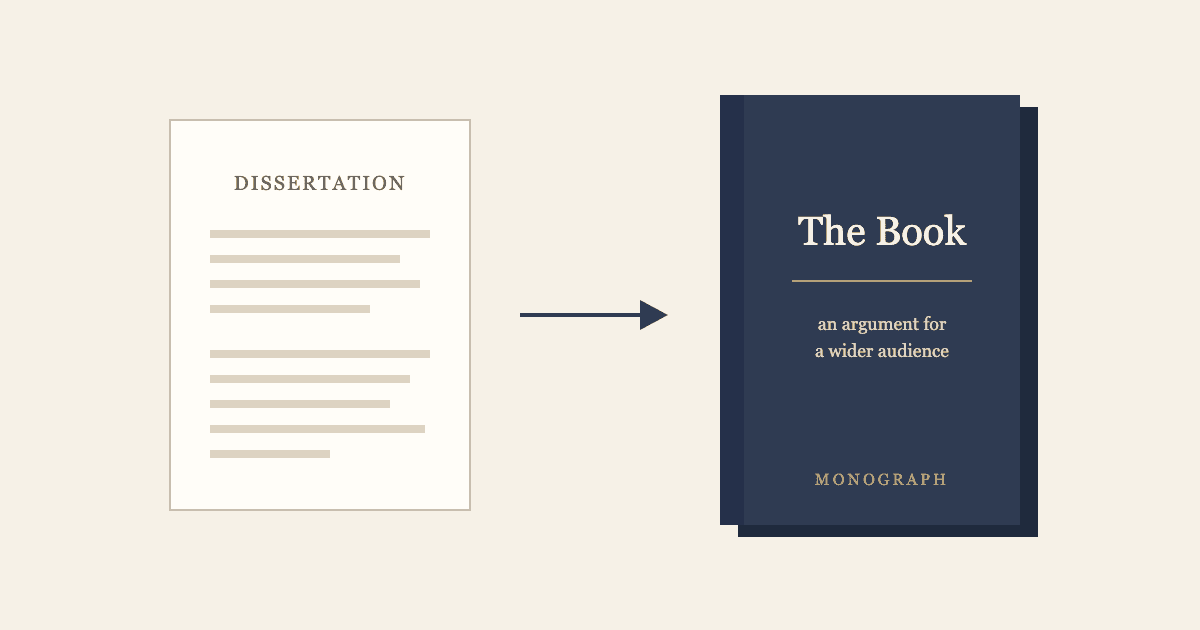
How to Turn Your Dissertation Into a Book
A dissertation proves you can do research; a book has to be read. See what changes between the two, a before-and-after outline example, a seven-step revision plan, and how to revise in SciVolume.
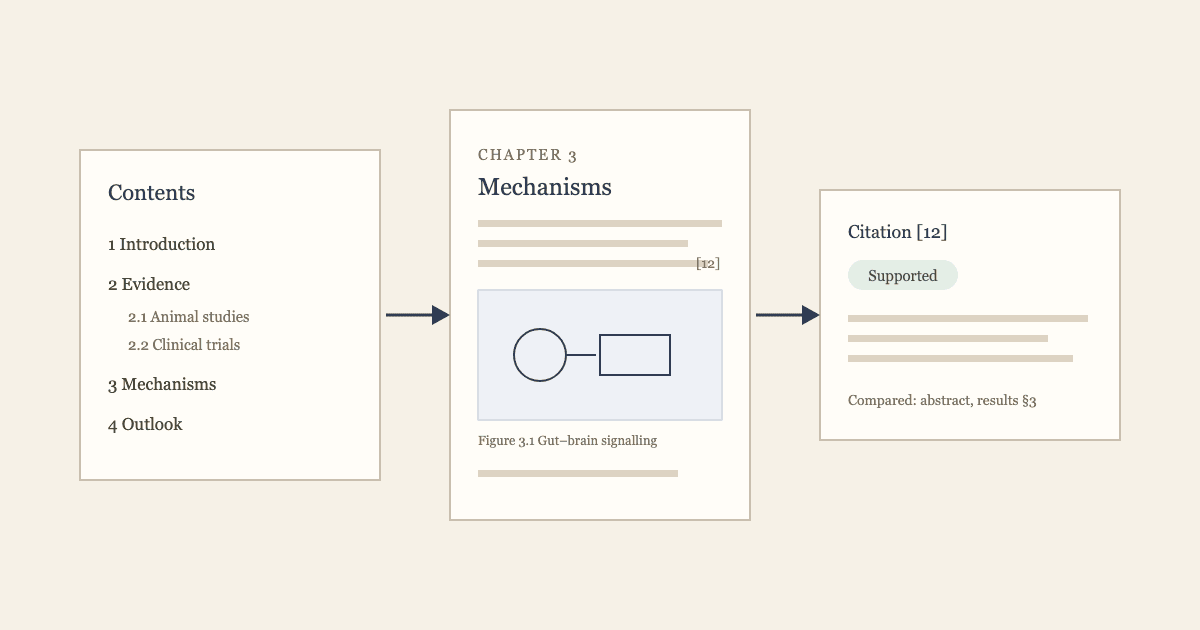
How SciVolume Writes a Book With Real Citations and Figures
From a topic to a manuscript you can hand in: how SciVolume plans the outline, cites only approved sources, checks every citation and adds scientific figures through the SciDraw AI API.
Newsletter
Join the community
Subscribe to our newsletter for the latest news and updates