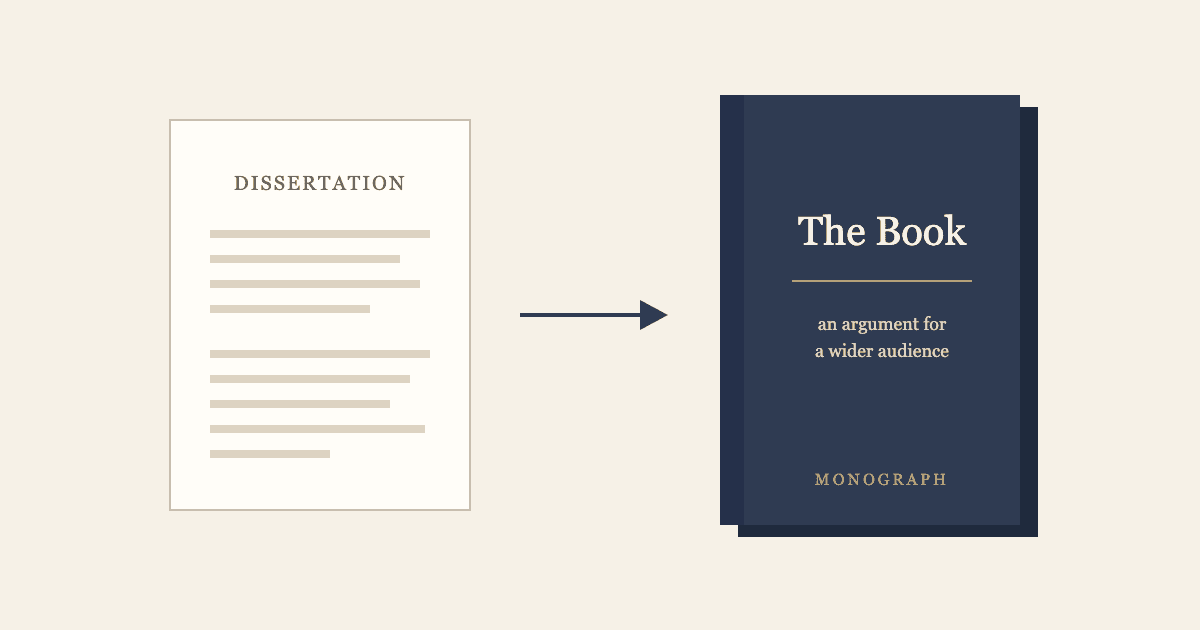
How to Turn Your Dissertation Into a Book
A dissertation proves you can do research; a book has to be read. See what changes between the two, a before-and-after outline example, a seven-step revision plan, and how to revise in SciVolume.
Short answer: do not submit your dissertation with a new title page. Publishers and readers expect a book that argues for a wider audience. In practice that means rewriting the introduction and conclusion, cutting most of the literature review and methods detail, restructuring chapters around your argument rather than your research process, and writing a proposal before you rewrite everything.
What changes between a dissertation and a book
A doctoral dissertation and a scholarly book often rest on the same archive, fieldwork, or dataset, yet they belong to two different genres. A dissertation is an examination document written for a small committee of specialists who are paid to read every page and verify that you have mastered the literature and methods of your subfield. A book is written for readers who choose to pick it up—scholars in neighboring disciplines, graduate students, or general readers—and who will put it down if the central claim is buried beneath defensive scaffolding.
| Dissertation | Book | |
|---|---|---|
| Reader | Your committee | Scholars beyond your subfield, students, sometimes general readers |
| Goal | Prove competence | Make an argument worth reading |
| Literature review | Long, defensive, comprehensive | Woven into the chapters, only what the argument needs |
| Methods | Detailed, often a whole chapter | Short, or moved to an appendix |
| Structure | Follows the research process | Follows the argument |
| Voice | Hedged | Confident and direct |
From proving competence to advancing a thesis
In a dissertation, you pause frequently to demonstrate that you have read the canon, anticipated methodological objections, and documented every step of data collection. In a book, the reader grants your basic competence from the outset. What the reader wants to know is what your evidence changes about how we understand the problem. Every chapter must push that central claim forward rather than merely reporting another slice of findings.
From defensive literature reviews to selective conversation
A standalone literature review chapter is the clearest hallmark of an unrevised dissertation. Acquisitions editors routinely ask authors to dismantle it. Instead of surveying every school of thought before presenting your own work, a book brings prior scholarship into the text only at the moment a specific debate bears on your argument. Scholars you agree with or build upon can be cited in footnotes or endnotes without interrupting the prose.
From research sequence to narrative architecture
Dissertations are typically organized around how the research was conducted: problem statement, literature review, methodology, empirical cases, discussion, and conclusion. A book is organized around how a reader learns and is persuaded. Theoretical framing belongs in the opening chapter alongside the core thesis; essential methodological choices are explained briefly in the introduction while technical protocols move to an appendix; and chapters follow a conceptual progression rather than the order in which you collected your data.
Before and after: an example of chapter restructuring
To see how structural revision works in practice, consider the following fictional social science dissertation example in urban sociology and public finance, comparing its original committee-facing table of contents with the revised book outline prepared for a university press.
Before: Fictional dissertation table of contents (example)
Working dissertation title (example): Municipal Fiscal Reform, Intergovernmental Transfers, and Local Public Goods Provision in Three Post-Industrial Cities
- Chapter 1: Introduction, Problem Statement, and Research Questions — Background of municipal fiscal distress, three formal research questions, definitions of terms, and chapter preview.
- Chapter 2: Literature Review — Comprehensive survey of fiscal federalism, urban austerity theories, public choice models, and street-level bureaucracy.
- Chapter 3: Research Design, Case Selection, and Methodology — Justification of the three-city comparative design, archival sampling strategy, interview coding codebook, and regression diagnostics.
- Chapter 4: Findings I — Budgetary Restructuring in City A — Chronological narrative of budget hearings and departmental interviews in the first field site.
- Chapter 5: Findings II — Grant Dependence in City B — Empirical findings from the second field site, organized by administrative agency.
- Chapter 6: Findings III — Service Contracting in City C — Empirical findings from the third field site, following the same template as the previous two chapters.
- Chapter 7: Cross-Case Discussion, Limitations, and Future Research — Synthesis comparing the three cases against the initial research questions, methodological caveats, and conclusions.
After: Revised book outline for a wider readership (example)
Revised book title (example): The Price of Maintenance: How Municipal Budgets Reshape Urban Public Goods
- Chapter 1: The Hidden Politics of Routine Maintenance — Opens with a concrete episode of infrastructure failure, states the book's central argument directly, weaves in only the essential debates on urban fiscal governance, and briefly explains the comparative study design.
- Chapter 2: Why Capital Projects Win and Maintenance Loses — Combines historical and institutional material from the dissertation's literature review and archival data to explain why city budget rules favor visible new construction over routine upkeep.
- Chapter 3: The Grant Trap in Post-Industrial Cities — Reorganizes material from City A and City B around the first mechanism of the argument: how earmarked intergovernmental grants reshape local priorities.
- Chapter 4: Outsourcing the Street — Draws on evidence from City C and comparative budget records to show the second mechanism: how service contracting shifts accountability away from neighborhood upkeep.
- Chapter 5: Who Bears the Cost of Deferred Repair — A newly framed thematic chapter synthesizing interview and neighborhood-level evidence across all three cities to trace the distributional consequences for residents.
- Chapter 6: Rebuilding Fiscal Capacity for the Everyday City — Delivers on the book's core argument, draws out implications for urban theory and municipal policy, and replaces defensive "limitations" with a clear concluding thesis.
- Appendix: Comparative Research Design, Archival Sources, and Coding Protocol — Preserves the methodological rigor of the original third chapter for specialist readers without slowing down the opening chapters.
In this example, Chapter 2 and Chapter 3 of the dissertation disappeared as standalone chapters: relevant debates moved into Chapters 1 and 2, while technical methods moved to the Appendix. Instead of three repetitive case reports ("Findings I, II, III"), the middle of the book is organized around analytical mechanisms that carry the argument from cause to consequence.
A revision plan in seven steps
- State the book's argument in two sentences. If you cannot, the book is not ready. A research question is not an argument; your two sentences must state the answer your book defends. Everything else is organized around this claim.
- Decide who the reader is. A monograph for specialists, a book for advanced students, or a crossover title for general readers. This decides how much disciplinary shorthand you cut and how much background you explain.
- Redraw the table of contents. Order chapters by argument. Merge thin chapters, split overloaded ones, and plan one or two new chapters if the argument needs them. You can also use a structured book outline generator to map out chapter aims, sections, and chapter-to-chapter progression from your existing materials.
- Cut and redistribute the literature review. Keep only the scholarly debates you actually join, and place each one in the chapter where it does analytical work.
- Shrink the methods. Explain enough in the main text for readers to trust the evidence; move sampling tables, coding protocols, and robustness checks to an appendix.
- Rewrite the introduction and conclusion last. Once the body chapters are settled, write an introduction and conclusion that promise and deliver the argument from step 1 rather than summarizing each chapter.
- Check permissions. If chapters were published as journal articles, read the publishing agreements; most allow reuse in a book with acknowledgment, and checking early prevents delays before submission.
Most academic publishers want a book proposal first: the argument, the audience, a chapter outline, comparable titles, and one or two sample chapters. Write it after step 3; it will also tell you whether the new structure holds.
Where AI helps, and where it should not
AI is useful for the mechanical, time-consuming parts of the revision:
- proposing a new chapter structure from your existing text and papers, which you then judge;
- drafting bridging passages and chapter introductions in your confirmed terminology;
- checking that every claim still has an approved citation after you move text around;
- importing a dissertation from Word, LaTeX, Markdown, PDF (including scanned PDFs), or DRM-free EPUB, renumbering figures and equations when chapters move, producing a translated edition, and exporting to Word, LaTeX, EPUB, or PDF.
It should not invent your argument, and it must never invent sources. Any tool you use should cite only references that exist in scholarly indexes or materials you have uploaded, and let you check each citation against the original passage.
How to do it in SciVolume
SciVolume provides a structured workspace for revising a dissertation into a book on a paid plan:
- Import Word, LaTeX, Markdown, PDF, or EPUB: Upload your dissertation at
/books/new?mode=importin Word (.docx), LaTeX (.texor multi-file.zip), Markdown (.md), PDF (direct text reading or AI page-by-page recognition for scanned PDFs), or DRM-free EPUB (EPUB 2/3), along with supplementary PDF papers, lecture notes, or BibTeX/RIS files. - Recognize structure: The workspace parses the manuscript and automatically identifies its existing table of contents and chapters so you can adjust them when confirming the outline (when importing a PDF or EPUB manuscript, PDF headers/footers, footnotes, images, and complex equations may need cleanup after import, and PDF/EPUB images need to be added back in the editor).
- Generate a reader-facing new outline: SciVolume proposes a new outline organized for book readers, showing each chapter's aim, its sections, and how chapters follow one another. You can rename, reorder, add, or remove chapters before confirming.
- Rewrite chapter by chapter: Revise in the editor with chapters on the left, text in the middle, and the assistant on the right; suggested edits appear as a comparison before you accept them. While writing or expanding sections, the workspace cites only real literature from scholarly indexes or your uploaded files, and paragraphs based on your materials carry a source mark for side-by-side reading. Confirmed glossary terms stay consistent book-wide, and figure, table, and equation numbers update automatically when chapters move. If you also need an edition in another language (Chinese, English, Japanese, German, French, or Spanish), you can create a paragraph-aligned translated manuscript with the AI book translator.
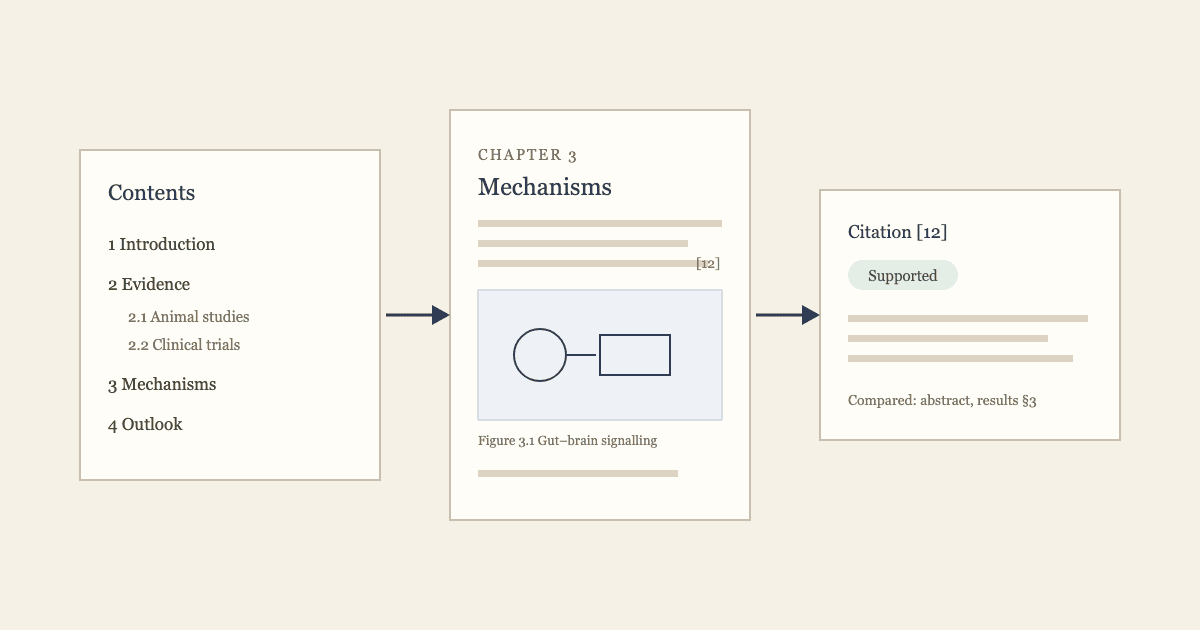
- Citation audit: Run the whole-book check for terminology consistency and the citation audit, which compares every citation against the original text and reports a finding of supported, not mentioned in source, or contradicted.
- Export: Switch the citation style as needed—APA, Chicago (author-date and notes), MLA, Harvard, IEEE, Nature, or GB/T 7714 (numeric and author-date)—and export your manuscript to Word, LaTeX, EPUB, or PDF.
Deliverables: what you receive at the end
At the end of the workflow, you receive concrete deliverables ready for submission or review:
- A complete book manuscript in Word, LaTeX, EPUB, or PDF: Exported on a paid plan as a Word (
.docx) package, a LaTeX package, an EPUB 3 ebook (for Apple Books, Kindle/KDP, etc., with figures and equations packaged and inline citations linked to the back-of-book bibliography), or a PDF (via print layout), complete with cover, chapter hierarchy, automatically numbered figures, tables, and equations, footnotes, and a unified bibliography. - A citation audit report: A chapter-by-chapter verification record comparing every citation against its source passage ("supported", "not mentioned", or "contradicted"), with source marks linking paragraphs back to your uploaded materials.
- Optional translated editions or textbook apparatus: If translating, an independent paragraph-aligned manuscript in your target language; if adapting the dissertation into a course textbook with the AI textbook generator, chapter learning objectives (4–6), summaries with key points (4–7), key terms (8–15), exercises (6–10 with reference answers), case studies (3–5 paragraphs with 2–3 discussion questions), further reading from cited works (4–8), a 16-week syllabus, and course slides.
To see what a finished SciVolume book looks like, read the sample book online, no account needed.
Frequently asked questions
Can I import a dissertation written in LaTeX, Word, or PDF?
Yes. At /books/new?mode=import, you can directly import a dissertation manuscript in Word (.docx), LaTeX (.tex, or a multi-file .zip project with \input/\include automatically expanded and .bib files imported), Markdown (.md), PDF (including scanned PDFs recognized page by page by AI), or DRM-free EPUB (EPUB 2/3), up to 60 MB per file and 3,000,000 characters per manuscript. Note that importing a PDF does not preserve the original PDF layout, headers/footers, footnotes, images, and complex equations may require cleanup after import, and images from PDF or EPUB files need to be added back in the editor (DRM-protected ebooks are not supported).
Will SciVolume invent references when rewriting chapters?
No. The workspace searches scholarly indexes and cites only works that exist there or in your uploaded materials. Afterward, the citation audit compares every citation with the original text and flags anything not mentioned or contradicted by the source.
Which citation styles are supported for book manuscripts?
APA, Chicago (author-date and notes), MLA, Harvard, IEEE, Nature, and GB/T 7714 (numeric and author-date). Citations are stored as reference objects, so changing styles does not break them.
Do I need a paid plan to import my dissertation and generate a book outline?
Yes. Free accounts can read the sample book at /demo (0 active manuscripts). Creating or importing a manuscript requires a paid plan: Scholar ($20/month or $120/year, 500 monthly credits, 1 manuscript), Pro ($50/month or $300/year, 2,000 monthly credits, 5 manuscripts), or Studio ($150/month or $900/year, 7,000 monthly credits, 20 manuscripts). Text generation costs 10 credits per 1,000 generated characters (an estimated 1,000 credits for 100,000 characters, calculated from the rule rather than a quote).
Is my unpublished dissertation used to train public AI models?
No. Your manuscripts and uploaded materials are used only for your own project and are never used to train public models.
Author

Categories
More Posts
How SciVolume Writes a Book With Real Citations and Figures
From a topic to a manuscript you can hand in: how SciVolume plans the outline, cites only approved sources, checks every citation and adds scientific figures through the SciDraw AI API.

Book Formatting Software Compared: Which Tool Fits Which Book (2026)
Compare 10 book formatting software tools by price, platform, EPUB and print PDF export, footnotes, equations, and indexing for trade and academic books.
Newsletter
Join the community
Subscribe to our newsletter for the latest news and updates