
How to Respond to Reviewer Comments: Structure, Examples, and a Copyable Template
Learn how to respond to reviewer comments with a clear structure, a fictional rebuttal letter example, a response to reviewers template, and key pitfalls.
Short answer: quote every editor and reviewer remark verbatim, answer each point separately right below it, state clearly whether you accepted, partially accepted, or respectfully disagreed on the basis of evidence, give the exact page and line numbers of every manuscript edit, and paste the revised wording directly into the letter so the reviewer can verify your revision without switching files.
What editors and reviewers look for in a resubmission
When a journal invites a major or minor revision, handling editors and referees rarely read the revised manuscript from page one in isolation. They open your point-by-point response letter first to verify whether you addressed methodological critiques, resolved ambiguities, and made each change easy to audit. Editorial guidance from Elsevier Researcher Academy and Elsevier Connect's recommendations on responding to reviewer comments rests on one practical rule: minimize the effort required for a busy referee to confirm what changed and why.
A standard journal resubmission consists of three coordinated files: (1) the point-by-point response letter, (2) a marked-up revised manuscript (using track changes, highlighting, or colored text as specified by the journal), and (3) a clean revised manuscript. Decide before writing whether your page and line citations refer to the clean copy or the marked-up file, and state that choice in your opening note to the editor.
Structure of a point-by-point response letter
A clear response document reads like an indexed reference record rather than an essay. As shown in published layouts such as the Virologica Sinica point-by-point response letter example hosted by Elsevier, separating quoted critiques visually from author replies and embedding revised passages keeps re-review efficient.
1. Cover note to the editor (Dear Editor)
Address the handling editor formally by name when known. State the manuscript ID and full title, thank the editor and reviewers for their time and critique, summarize the two to four largest revisions across the manuscript (such as a new control analysis, expanded discussion boundaries, or restructured methods), and state how edits are marked in the revised file.
2. Response to the editor
Decision letters often include editorial requests above the referee reports—such as formatting data-availability statements, supplying ethics approval numbers, trimming abstract length, or prioritizing a specific statistical critique. Address every editorial item in a dedicated Response to the Editor section before Reviewer #1.
3. Reviewer-by-reviewer threads (Response to Reviewer #1, #2, …)
Give each referee a separate heading. Whenever a reviewer raises multiple issues inside one long paragraph, split it into numbered items (Comment 1.1, Comment 1.2, …) while preserving the exact original wording. Under each numbered comment, include four elements:
- The comment, quoted verbatim: Set the critique off in italics, boldface, or a blockquote so comment and reply are visually distinct.
- Your response and stance: State plainly what you did—accepted the point, addressed the underlying concern within your study's constraints, or retained your approach with supporting evidence—followed by concise scientific reasoning.
- Location of the change: Cite the exact section, page number, and line range (for example, Section 2.3, Page 8, Lines 194–206 of the clean manuscript), plus any updated figure, table, or supplement labels.
- Revised text or figure: Paste the exact revised sentences (or updated figure/table) directly below your explanation, as recommended in Elsevier's peer-review response guidance.
4. Closing, signature, and summary list of changes
Close in one or two sentences on behalf of all co-authors, sign with the corresponding author's name, and append a brief List of changes summarizing major updates across sections.
How to write the three types of responses
Deciding how to respond to reviewer comments begins with choosing an explicit stance on each critique before drafting prose.
| Stance | When to choose it | What the response must include | What to avoid |
|---|---|---|---|
| Full acceptance | The comment identifies a genuine gap, missing control, citation, or ambiguity you can resolve | Direct statement of agreement, summary of the edit or analysis, exact page/line location, and pasted revised text | Writing bare replies like "Done" without showing the new wording |
| Partial acceptance | The scientific concern is valid, but the requested experiment or cohort exceeds ethics approval, archived samples, or scope | Acknowledgment of the valid concern, concrete check or scope boundary added, objective reason why the full request was not feasible, and pasted text | Dismissing the point as "future work" while leaving the manuscript unchanged |
| Evidence-based disagreement | The critique rests on a factual misreading, contradicts methodological assumptions, or conflicts with data already shown | Courteous restatement, empirical data or verified citations supporting your position, and a clarifying edit in the manuscript | Arguing from opinion without citing evidence or clarifying ambiguous prose |
1. Full acceptance
When a referee spots an omitted methodological parameter, an unclear axis label, or an overstated conclusion, accept the critique directly. Skip repetitive flattery at the start of every item; clear execution carries far more weight. State what changed, give the page and line numbers, and paste the updated passage.
2. Partial acceptance
Referees occasionally request multi-year fieldwork or an assay for which biological specimens no longer exist. Treat the underlying concern—usually confounding, external validity, or mechanism—as legitimate even when the exact experimental prescription cannot be run. Explain transparently why the full experiment is not feasible, perform the strongest check available within your dataset (such as a sensitivity analysis or subgroup stratification), narrow your claims in the Discussion to match your evidence, and quote the added limitation passage.
3. Evidence-based disagreement
When a referee overlooks a control already in the supplement or recommends a statistical test whose assumptions your data violate, rebut with data rather than defensiveness. First, take responsibility if dense phrasing invited misreading. Second, cite diagnostic statistics, supplementary tables, or peer-reviewed literature supporting your choice. Third, add a clarifying sentence to the manuscript itself—because if a careful reviewer misread the passage, future readers will too—and quote that clarification in your letter.
Tone, confidentiality, and journal AI policies
Keep every reply calm, factual, and self-contained. Remove defensive modifiers ("obviously," "as already stated on page 4"). If Reviewer #2 asks a question already answered under Reviewer #1's Comment 1.3, summarize the core answer in two sentences for Reviewer #2 rather than writing a bare "See Reviewer 1," cross-referencing Comment 1.3 only for extended tables.
Remember that peer-review reports and submitted manuscripts are confidential documents. Before pasting review text into external tools, check the journal's confidentiality rules: some publishers explicitly prohibit uploading manuscripts or review material to public AI platforms—for example, Social Sciences in China Press stipulates that submitted and reviewed manuscripts must not be uploaded to public AI platforms. Across international journals, ICMJE authorship and contributor recommendations, Elsevier's generative AI policies for journals, and Wiley's publishing ethics guidelines require transparent disclosure when AI tools are used beyond basic grammar checks and forbid fabricating data or citations. Every reply must reflect only changes and analyses actually completed.
Five common mistakes that delay re-review
- Bundling multi-part comments. Leaving the third question inside a long paragraph unanswered often triggers another revision round; split compound remarks into
1.4a,1.4b, and1.4c. - Omitting page/line coordinates or pasted wording. Writing "Expanded in the Discussion" forces reviewers to search several pages for two new sentences.
- Answering only in the letter. Explaining a caveat to the referee without editing the manuscript leaves future readers with the same gap.
- Line-number drift. Editing the manuscript after drafting the response letter shifts pagination; verify every page and line number against the final submission proof.
- Cross-reviewer contradictions. Check that edits made for Reviewer #1 do not silently conflict with additions made for Reviewer #2.
Response to reviewers example (fictional rebuttal letter excerpt)
The fictional manuscript example below in urban hydrology (JWR-2026-0418, "Permeable Pavement Aging and Dissolved Zinc Retention Across Four Freeze–Thaw Cycles") demonstrates all three stances; all identifiers, data, and comments are invented for illustration.
Dear Dr. Alvarez,
Thank you for inviting a revision of Manuscript JWR-2026-0418. We thank you and both reviewers for the constructive assessment. We have (1) added unspiked PVC column blank controls in Section 2.2 and Table S1, (2) added a fine-silt clogging sensitivity analysis and bounded our field extrapolation in Section 4.3, and (3) reported parametric Welch's t-test checks alongside our primary non-parametric tests in Table S3. Changes appear in blue text in the marked-up file; page and line numbers below refer to the clean manuscript.
Reviewer #1, Comment 1.1: "Section 2.2 does not report dissolved zinc background levels from unspiked deionized water passing through the PVC column hardware, making hardware leaching or adsorption unclear."
Response (Accepted): We agree. Prior to Cycle 1, triplicate unspiked blank columns were run at 12 mL/min; effluent Zn stayed below the ICP-MS detection limit (0.4 µg/L) across all 24 blank fractions, and spike recoveries averaged 98.2% ± 1.9%. We added these controls to Section 2.2 and Supplementary Table S1.
- Location: Section 2.2, Page 6, Lines 142–147; Table S1.
- Revised text: "Triplicate unspiked reagent-water blanks run at
12 mL/minprior to Cycle 1 remained below the method detection limit (0.4 µg/L), and matrix spike recoveries averaged98.2% ± 1.9%(Table S1)."
Reviewer #1, Comment 1.2: "Laboratory chambers omit tire abrasion. Add a two-winter parking-lot monitoring campaign to confirm outdoor zinc breakthrough."
Response (Partially accepted): We agree that field pavements experience tire shear and heterogeneous sediment absent from thermal chambers. A new two-winter field campaign is beyond the scope and archived core inventory of this mechanistic study, which was designed to isolate freeze–thaw microcracking. To test sensitivity to field fines, we analyzed the silt-loading subset (d50 = 18 µm, Figure S4) collected in Cycle 4 and revised the Abstract and Section 4.3 to bound our conclusions to thermally driven aging.
- Location: Abstract, Page 2, Lines 28–30; Section 4.3, Page 15, Lines 388–395; Figure S4.
- Revised text: "Because chamber cycling isolates thermal stress from vehicular shear, our breakthrough curves represent an upper bound under thermal aging alone; in supplementary silt tests (
d50 = 18 µm; Figure S4), surface clogging reduced infiltration by31%before chemical saturation."
Reviewer #2, Comment 2.1: "In Section 3.1, replace Mann–Whitney U tests (n = 12 per mix) with two-sample Welch's t-tests for greater power."
Response (Respectfully disagreed on primary test; robustness check added): We retained Mann–Whitney U as our pre-specified primary test because post-thaw concentrations in Mix B showed marked right-skewness from two microcracked cores (Shapiro–Wilk W = 0.79, p = 0.007), violating small-sample normality. However, we ran Welch's t-tests on raw and log10-transformed concentrations; all directional findings (alpha = 0.05 after Holm–Bonferroni correction) held. We added these checks in Table S3 and clarified Section 2.4.
- Location: Section 2.4, Page 8, Lines 203–208; Table S3.
- Revised text: "Given significant right-skewness in Mix B (
W = 0.79, p = 0.007), groups were compared using two-sided Mann–Whitney U tests with Holm–Bonferroni adjustment; Welch's t-tests on raw and log10-transformed data yielded consistent results (Table S3)."
Copyable response to reviewers template
Adapt this response to reviewers template for your resubmission:
# Response to Reviewers
- **Manuscript ID:** [Insert ID]
- **Title:** [Insert Title]

## Dear [Editor's Name / Editor],
Thank you for considering our manuscript ("[Insert Title]", ID: [Insert ID]) and forwarding the reviewers' critiques. Our main revisions include: (1) [Major change 1]; (2) [Major change 2]; (3) [Major change 3]. Edits are marked via [track changes / highlighting / colored text]; page and line numbers below refer to the [clean / marked-up] manuscript.

## Response to the Editor
### Editor Comment 1
> "[Paste editor's exact comment.]"
**Response:** [State how the request was fulfilled.]
- **Location:** [Page X, Lines Y–Z]
- **Revised text:** "[Paste updated wording.]"

## Response to Reviewer #1
### Comment 1.1 [Accept]
> "[Paste comment verbatim.]"
**Response:** We agree and have [summarize new analysis or edit].
- **Location:** [Section X.Y, Page X, Lines Y–Z]
- **Revised text:** "[Paste revised sentences.]"

### Comment 1.2 [Partially accept]
> "[Paste comment verbatim.]"
**Response:** We agree that [acknowledge valid concern]. While [state objective constraint], we addressed this point by [describe added check and scope limitation].
- **Location:** [Section X.Y, Page X, Lines Y–Z]
- **Revised text:** "[Paste added passage.]"

### Comment 1.3 [Respectfully disagree]
> "[Paste comment verbatim.]"
**Response:** Thank you for highlighting this point. We retained [method/claim] because [cite empirical data or verified references], and clarified our exposition in Section [X.Y] so the rationale is explicit.
- **Location:** [Section X.Y, Page X, Lines Y–Z]
- **Revised text:** "[Paste clarified sentences.]"

## Closing
We hope these revisions address all comments and remain available for further questions.
Sincerely, [Corresponding Author Name], on behalf of all co-authors

## List of Changes
- **[Section / Page]:** [Summary of change]
Drafting a point-by-point response in SciVolume
Keeping dozens of referee sub-comments, stances, manuscript edits, and page-and-line citations synchronized is easier in a structured workspace. SciVolume provides English and Chinese templates in its response to reviewers workspace designed around author-verified revisions:
- Split and verify remarks in the Comments panel: Paste the decision letter or supervisor notes into the Comments panel; the workspace splits them into individual items for you to check, and lets you link your original manuscript.
- Choose a stance before any drafting runs: For every item, you must first select Accept, Partially accept, or Disagree and note the actual changes made; items without a selected stance cannot be drafted. Drafting organizes only the stance and actual edits you supply—missing details are marked
[To add: …]rather than invented, and citations use only verified literature. - Edit, check, and export to Word: After confirming the document plan, you revise each reply in the editor while the back-matter List of changes compiles from your change notes. Free rule-based checks verify—without calling a model—required sections, full comment coverage, leftover placeholders, and page/line references before you export a Word (
.docx) file (with PDF print preview and an optional editable AI-use disclosure draft) on a paid plan. Your manuscripts and confidential review materials are used only for your project and never to train public AI models.
Author

Categories
Dear Editor)2. Response to the editor3. Reviewer-by-reviewer threads (Response to Reviewer #1, #2, …)4. Closing, signature, and summary list of changesHow to write the three types of responses1. Full acceptance2. Partial acceptance3. Evidence-based disagreementTone, confidentiality, and journal AI policiesFive common mistakes that delay re-reviewResponse to reviewers example (fictional rebuttal letter excerpt)Copyable response to reviewers templateDrafting a point-by-point response in SciVolumeMore Posts

How to Write an NSFC (National Natural Science Foundation of China) Proposal: Section-by-Section Guide
A section-by-section guide to the 2026 NSFC General Program outline, locked headings, Young Scientists Fund (A/B/C) rules, and AI disclosure policy.

How to Write an NIH Specific Aims Page: Structure, Policy Rules, and Template
How to structure a one-page NIH Specific Aims page, avoid interdependent aims, follow NOT-OD-25-132 AI rules, and start from a Specific Aims page template.
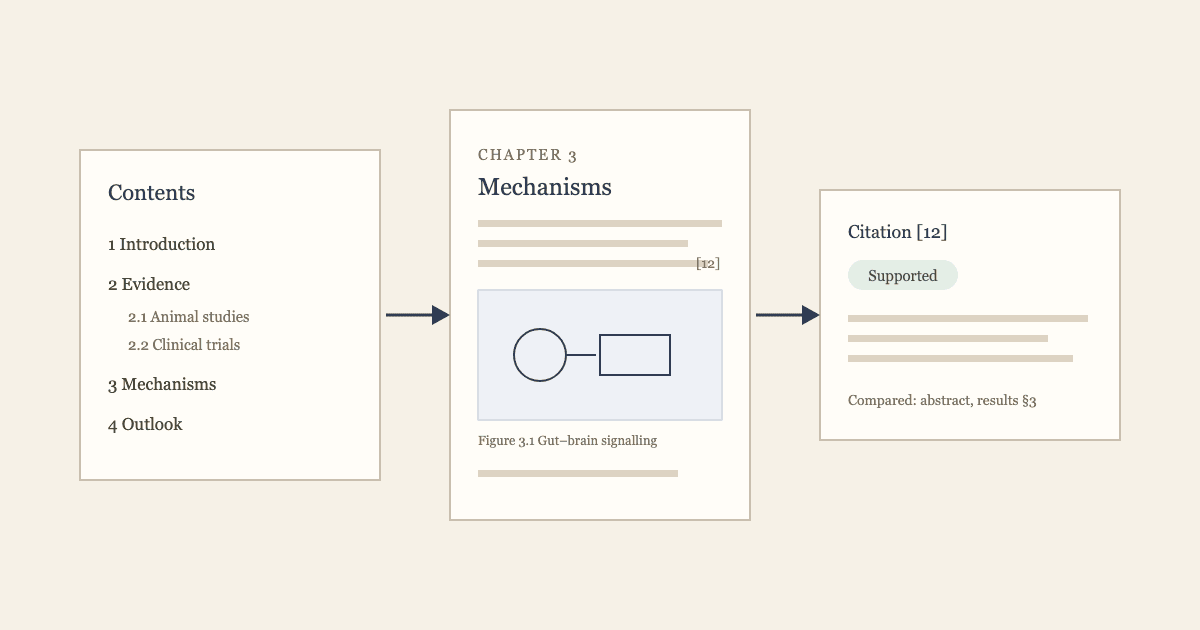
How SciVolume Writes a Book With Real Citations and Figures
From a topic to a manuscript you can hand in: how SciVolume plans the outline, cites only approved sources, checks every citation and adds scientific figures through the SciDraw AI API.
Newsletter
Join the community
Subscribe to our newsletter for the latest news and updates